

Concerning Bad Bunny
or, Why Simon Bolívar would have been a fan

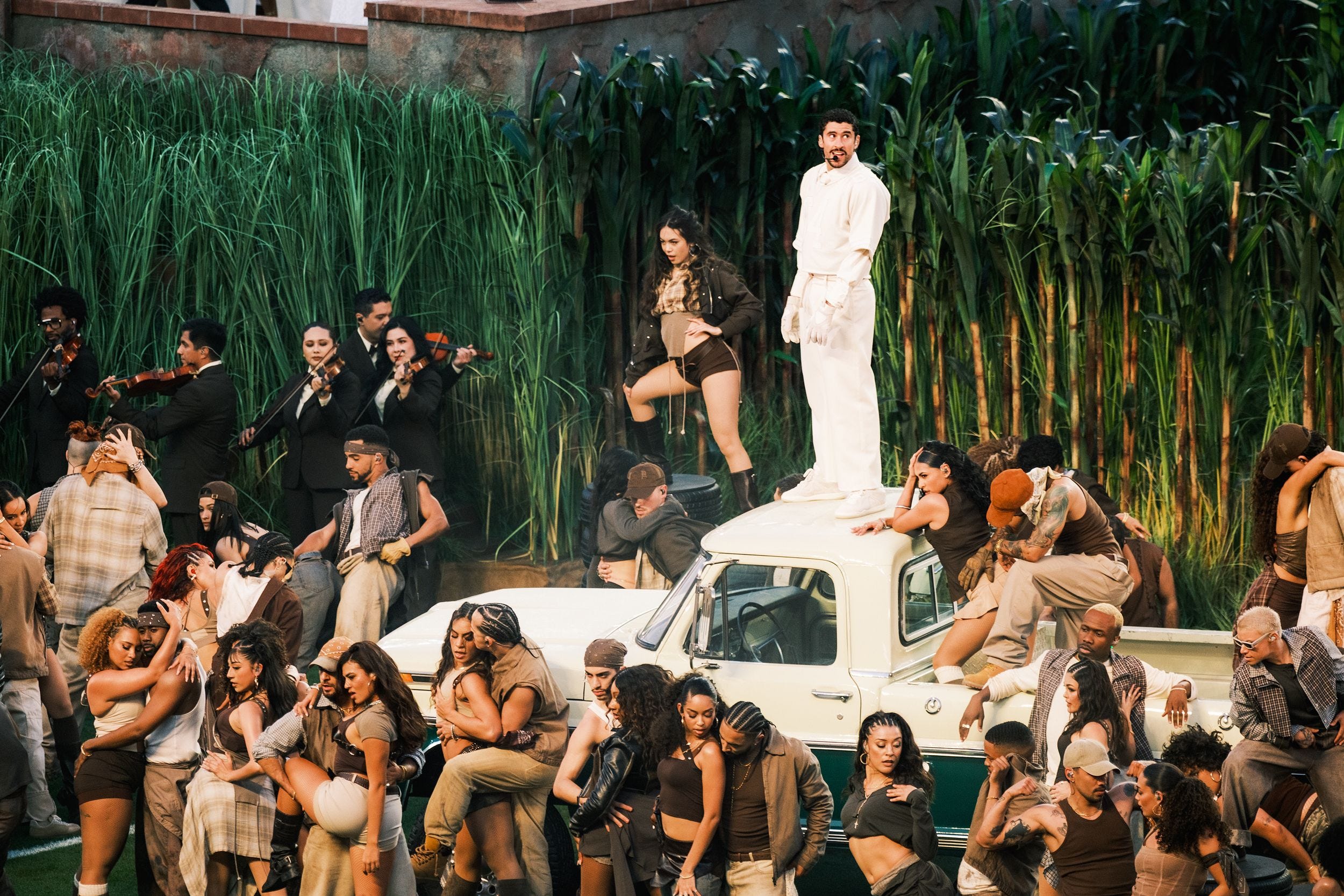
We begin in a field of sugar cane. For centuries, this was Puerto Rico, at least to the outside world. The camera pans across seemingly endless rows of tall green stalks, between which machete-wielding jíbaros undertake the backbreaking labor of transforming the plant into the substance that graces countless kitchen tables the world over. Our guide is Benito Antonio Martínez Ocasio, better known as Bad Bunny, clad completely in white, a Virgil-like guide through the inferno which is now the US. What follows is a tour of Puerto Rico from the margins: a nail salon, a construction site, a taquero, a pair of boxers, old men playing dominos, vendors of piraguas and coco frío, the “Compro oro y plata” stand one might find in any disadvantaged Spanish-speaking neighborhood. Bad Bunny is astride a pink casita with a satellite dish on the roof, the very sort that might carry his performance to the island itself. In what would be the front yard, a troop of female dancers seem to represent every possible shade of brown. Below, a pari de marquesina attended by Cardi B, Pedro Pascal, and Jessica Alba, like a non-cringey version of Taylor Swift’s “girlsquad,” more palatable because the feel isn’t one of bolstering oneself through the celebrity of others, but of a magnetism so strong it pulls even A-listers into its orbit.
Yet despite its unmistakable Puerto Rican roots, Bad Bunny also displays a mastery of white culture. Grammy Award-winning Nicaraguan conductor Giancarlo Guerrero director a group of young violinists—the orchestral instrument par excellence—to introduce Bad Bunny’s “MONACO.” The post-modern blurring between fact and fiction that many continue to mistakenly believe to have arisen in Europe intensifies in a real wedding officiated by Rev. Antonio Reyes, originally from Mexico, an event made possible when Bad Bunny invited a couple who invited him to their wedding to instead tie the knot on national television. The crowd parts to reveal surprise guest Lady Gaga. Unlike the eclectic street style up to this point, Los Sobrinos (the backup band) is clad in matching suits over shirts with wide ’70s collars splayed open to reveal bare chests and gold chains. Lady Gaga herself is in a simple blue dress offset by a massive red boutonniere, her platinum blonde hair in loose waves that evoke the late Eva Perón; her wedding hit “Die with a Smile” reinterpreted through a salsa lens by Puerto Rican producer “Big” Jay Anthony Núñez.
Then, Bad Bunny bridges the gap between island and mainland, falling backwards onto a sea of outstretched arms for “NuevaYol,” his ode to the undisputed center of the Puerto Rican diaspora in the US. A barber shop with a Puerto Rican flag in the window, a marqueta with a neon “open” and “we accept EBT” signs. The dancers sport colorful jerseys, fresh fades, huge hoops, tight cornrows, and cut-off shorts; they break into a synchronized choreography around Bad Bunny, who casually breaks to take a shot with Toñita, owner of one of the last Puerto Rican social clubs in New York. Suddenly, the camera shifts to a young boy watching Bad Bunny’s recent Grammy acceptance speech with his parents, leading to speculations that the boy was Liam Ramos, the five-year-old who went viral after being detained by ICE in Minneapolis. Although the boy is meant to represent a young Bad Bunny, the misrecognition is understandable, as a young Benito could have easily been swept up by the sloppy and violent raids that we have collectively allowed to become commonplace in this country.
These intergenerational moments crop up constantly, as in the next featured guest, Ricky Martin, who sings “Lo que le pasó a Hawaii,” a cautionary tale about the perils of US statehood from the perspective of Hawaii. Martin, of course, is one of the best-selling Latin music artists of all time. Having first come to prominence as a member of the Puerto Rican boy band Menudo, Martin’s success during the late ’90s helped demonstrate the financial viability of Latin music in the US, thus paving the way for future artists like Bad Bunny. The reappearance of jíbaros hanging from electric poles extends the temporal horizon even further, recognizing the impacts of colonialism both in the sugar industry and the power outages that plagued the island in the aftermath of Hurricane María. Emerging from the grass beneath the jíbaro powerline dancers, Bad Bunny carries a massive Puerto Rican flag—notably not the official one adopted after its establishment as a commonwealth, but the older one of the pro-independence Revolutionary Committee of Puerto Rico, which dissolved in 1898.
The miniature concert ends with Bad Bunny naming every country of in the Americas while leading a procession of the flags of each, including English-speaking ones. This was the dream of Simón Bolívar, a criollo (Spaniard born in the “New World”) who led what are now the countries of Bolivia, Colombia, Ecuador, Panama, Peru, and Venezuela to independence from the Spanish Empire, earning him the honorific El Libertador. Alongside leaders like Francisco de Miranda, Bolívar sought to create unified Hispano–American republic. While several supra-national entities briefly existed, the vision of a pan-Hispanic America capable of defending itself against its mother country would never come to pass. As history has taught us, however, the greatest threats to Latin America were much closer to home.
When President James Monroe proclaimed his eponymous Doctrine in 1823, it was a bit of an empty threat without a military capable of backing it up. But after two wars, Europe turned its attention inward, leaving the Western hemisphere to the US, which was eager to take advantage of the situation. The US built the post-WWII international order to its own benefit, which proved especially valuable during the Cold War, when under the auspices of Operation Condor, it facilitated the assassinations of between 60,000 and 80,000 suspected Leftist sympathizers across Latin America for over a decade. One of the cruel ironies of our immigration crisis is that the US is itself to blame for the situation within which it finds itself. After destabilizing an entire region through extrajudicial killing and political interference, the foreign policy “experts” somehow feign when the flames come to lick their own doors.
But the possibilities! With well over 600 million inhabitants, Latin America represents almost 10% of the world’s population. The region is also much younger than the “First World,” having a median age of 32 in contrast to the US at 39 and a geriatric EU at 45. As the US birthrate continues to plunge, the US will need to open its doors to sustain the tax base needed to support its (albeit meager) social welfare programs. Due to its geographic and cultural proximity, Latin America is the most promising source for this demographic influx. And in terms of its own sluggish economic development, Latin America stands to gain immensely from transnational cooperative structures such as the (admittedly beleaguered) European Union. As we witness the death throes of US empire, imagine a united continent, one strong enough that a US president would never dream of kidnapping a head a state in the dead of night, as it did with Nicolás Maduro. Imagine Gustavo Petro calling for an “army of nations” to defend Palestine from the floor of the UN with a tenth of the world at his back. Imagine a Puerto Rico with the colonizer’s boot finally off its neck. Imagine.